HN Debrief

Deciphering basmala

  • Programming
  • Design
  • Internationalization
  • Typography
  • Languages

The post takes a famous Arabic calligraphic formula, the basmala, and patiently decodes how its letters are packed, stretched, and rearranged so a non-reader can see how the phrase is still recoverable inside decorative writing. It is partly a language explainer and partly a reminder that Arabic calligraphy is not just cursive text with extra flourishes. Letter forms shift with position, words can be compressed or elongated, and ornamental styles can move the eye in directions that look baffling if you only know Latin scripts.

If your product touches multilingual text, do not treat Arabic as just another left-to-right string with shaping bolted on later. Test real glyphs, real fonts, and real platform fallbacks, because rendering differences can change both legibility and layout in ways your UI assumptions will miss.

Discussion mood

Curious and appreciative, with a strong technical bent. People liked the article as a doorway into Arabic calligraphy, but the energy quickly shifted to practical rendering headaches, Unicode oddities, and respect for how much complexity text engines hide when they handle Arabic correctly.

Key insights

  1. 01

    One glyph breaks terminal layout assumptions

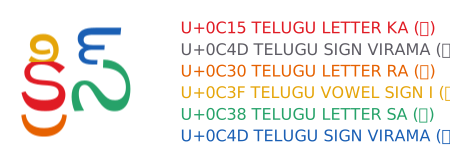
    Using the basmala ligature as a single-character example exposes why text layout cannot be done from code points alone. Its width and height vary wildly by font, so any system that assumes fixed character metrics without full font knowledge will mis-measure, clip, or misalign even before it reaches harder shaping cases like Telugu.

    If you build terminals, editors, or measurement code, stop treating Unicode scalar values as layout units. Base cursor movement, wrapping, and hit testing on shaped glyph runs from the actual font stack.

      Attribution:
    • chrismorgan #1
  2. 02

    Language fallback changes the script style

    Apple’s rendering appears to switch to Noto Nastaliq Urdu in some contexts, and commenters tied that to language preferences and possibly to the ligature’s Urdu and Pakistani usage history. That explains why the exact same character can flip between a wide Naskh-like look in one app and a steep Nastaliq look in another without any explicit user font choice.

    Do not debug Arabic rendering as if font selection were stable across an operating system. Test with different locale settings and text controls, because fallback logic can silently change the visual style and the space your UI must reserve.

      Attribution:
    • saadat #1
    • ivanbakel #1
    • Cthulhu_ #1
  3. 03

    Arabic calligraphy changes reading path, not just shape

    The hard part for non-readers is not only unfamiliar letters. Calligraphic Arabic can elongate strokes with tatwil or kashida, stack forms, and route the eye from lower right toward upper left or along ornamental paths that would look broken in Latin typography. That is why “just render the letters correctly” still falls short of the quality people expect from good Arabic typography.

    If you support Arabic in design tools, publishing, or branding, treat calligraphic layout as a separate quality bar from basic script support. Bring in native readers or specialists before shipping anything ornamental or high-visibility.

      Attribution:
    • noufalibrahim #1
    • slim #1
    • smusamashah #1
    • downsplat #1
  4. 04

    Quranic standardization shaped written Arabic

    A secular historical framing in the comments argued that written Arabic was unified around the Quraysh dialect as the Quran spread, then later non-Arab scholars codified grammar and added diacritic systems to stabilize reading. That gives useful context for why Quranic phrases carry such weight in both language learning and script tradition.

    When working on Arabic educational or religious products, expect strong coupling between language, script norms, and Quranic convention. You cannot cleanly separate typography from historical standardization.

      Attribution:
    • n4r9 #1

Against the grain

  1. 01

    Numerology claims are easy to overfit

    A commenter used the basmala as an entry point into Quranic number-pattern claims and argued that many “multiple of 19” results are what you should expect if you keep trying enough letter-to-number combinations under the Abjad system. The linked test suite was offered less as proof of miracle claims than as a way to show how selection effects can manufacture them.

    Be cautious when numeric patterns around sacred text are presented as evidence of hidden structure. Ask how many alternate counts, encodings, and stopping rules were available before the pattern was chosen.

      Attribution:
    • flossly #1

In plain english

Abjad
A system that assigns numerical values to Arabic letters, allowing words to be interpreted as numbers.
basmala
The Arabic phrase 'In the name of God, the Most Gracious, the Most Merciful,' commonly written at the start of many Islamic texts.
diacritic
A mark added above or below a letter to indicate pronunciation or distinguish similar letter shapes.
kashida
A term often used in typography for elongating Arabic letter connections to justify or decorate text.
Kufic
An older, angular style of Arabic script often used in decoration and architectural inscriptions.
ligature
A single written form that combines multiple letters or characters into one joined shape.
Naskh
A common Arabic script style known for being relatively clear and readable in books and printed text.
Nastaliq
A calligraphic style used especially for Persian and Urdu, with a flowing diagonal layout and more dramatic shaping than Naskh.
Noto Nastaliq Urdu
A digital font designed for Urdu text in the Nastaliq calligraphic style.
Quraysh
The tribe of Mecca associated with the Prophet Muhammad and often linked to the dialect used in early Quranic standardization.
tatwil
An Arabic text elongation stroke used to stretch connections between letters for spacing or decorative effect.
Thuluth
An ornamental Arabic script style often used for headings and decorative religious writing.
U+FDFD
The Unicode code point for a special Arabic ligature representing the basmala phrase as a single character.
Unicode
A computing standard that assigns numbers to characters and symbols so text can be stored and exchanged consistently across systems.

Reference links

Arabic rendering and typography

Unicode and text tools

Background references and examples