The article is about a Chinese memory-chip company, CXMT, whose stock surged after listing as investors piled into the idea that China can build a serious domestic DRAM industry while memory prices rise on AI demand. DRAM is the main working memory used in computers and servers. HBM is the faster, denser memory paired with AI accelerators. The basic claim is that memory has gone from a commodity component to a strategic bottleneck, and that Chinese producers may be entering at exactly the moment AI systems are pulling far more value into that layer of the stack.
The sharpest read was that the market move only makes sense if you believe memory is now part of the AI arms race, not a side character to GPUs. Several people pointed out that even without extreme lithography, CXMT can still be competitive in mainstream DRAM because leading-edge tools matter more for top-tier HBM than for
DDR5. That makes the company relevant much sooner than skeptics assume. Others pushed the idea further and argued that if China can make DRAM cheaply enough, it could lower the cost of local AI inference and weaken one of the remaining non-
GPU constraints on Chinese compute.
The bigger conversation sprawled into industrial policy. Europe took the most heat. People argued that Europe still has world-class positions in tooling through
ASML and in some industrial and automotive niches, but lacks the appetite to build new mass-market chip businesses and keeps trying to fit new technology into old industries. The US got a different critique. Commenters said America still leads in chip design and high-end compute, yet risks underinvesting in memory capacity and making itself more expensive if policy blocks cheap Chinese components without expanding friendly supply fast enough. Across both regions, the recurring point was blunt: China keeps picking sectors, enduring ugly economics, and scaling until it owns meaningful share.
There was also a long side debate on whether AI will keep demanding ever more memory. The consensus leaned toward “yes, for frontier systems,” even if smaller and more efficient models keep improving. Compression, Mixture of Experts, retrieval, and model-to-silicon tricks may push strong capabilities onto consumer hardware. But most people did not think that kills demand for memory. It just broadens the market from hyperscalers to laptops, phones, and edge devices. In that framing, cheaper DRAM is not bearish for memory makers. It is what makes the next wave of AI deployment possible.
bbc.com
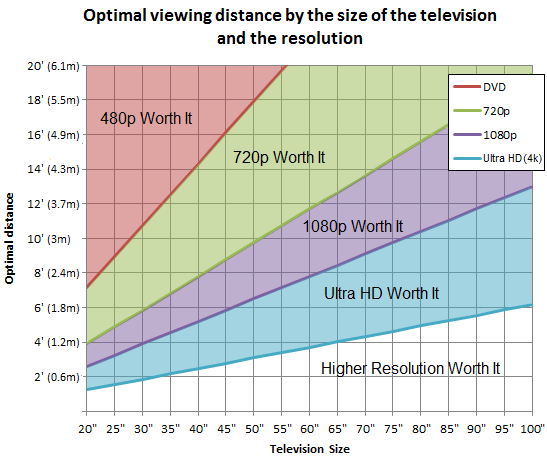 RTINGS optimal TV viewing distance graph