HN Debrief

AMD acquires Taalas to boost inference performance by etching models in silicon

  • AI
  • Hardware
  • Infrastructure
  • Semiconductors

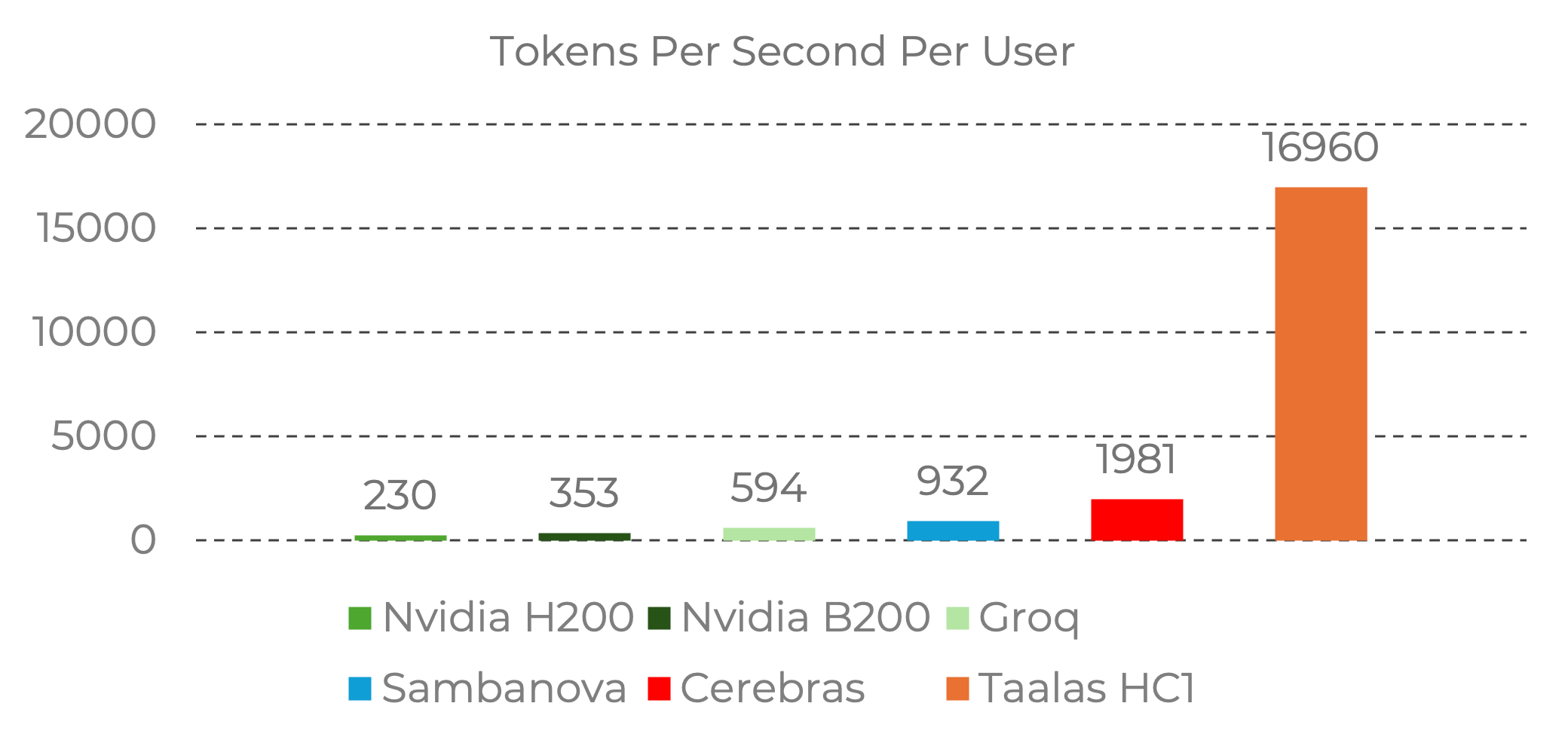
The news is that AMD acquired Taalas, whose pitch is unusual even by AI chip standards. Instead of using general GPUs to repeatedly fetch model weights from external memory, Taalas encodes weights directly into chip structures so inference can run at very high token rates with much less memory traffic. The live demo people kept trying, chatjimmy.ai, appears to run a Llama 3.1 8B-class model and feels instant. That speed, not model quality, drove the excitement.

Treat this as a play for stable, high-volume inference workloads, not a path to always-on frontier AI. If you run internal agents, classification, search, vision, or privacy-sensitive workflows, watch for older but fast models to become a distinct infrastructure tier with very different cost and latency economics.

Discussion mood

Mostly excited about the demo speed and the idea of a new low-latency inference tier, but skeptical about how far the approach scales. The enthusiasm came from seeing instant responses and imagining cheap subagents or private local AI. The skepticism came from die area, power, fabrication lead times, and the risk that etched models age out before the hardware pays back.

Key insights

  1. 01

    Best fit is boring production workloads

    The strongest practical case is not a chatbot that competes with the latest cloud model. It is high-volume tasks that are already satisfied with flash-tier intelligence, like classifying inbound messages, answering from docs, private office search, or running vision on a device. That framing turns model age from a problem into a purchasing decision. If a slightly older model is already over the quality threshold, the business wins come from speed, privacy, and lower unit economics.

    Map your AI usage by quality threshold, not by model brand. Any workflow already running on a cheap fast model is a candidate for a future fixed-function inference tier.

      Attribution:
    • craftkiller #1
    • preommr #1
    • XCSme #1
    • cephei #1
  2. 02

    Extreme throughput changes agent design

    Very high token rates are not just a nicer chatbot experience. They make it practical to fork many candidate reasoning paths, compare outputs, and chain tool calls until the bottleneck shifts away from inference and toward the external systems being called. That makes smaller models more useful than their benchmark scores suggest because you can buy capability with parallel tries and fast iteration.

    If latency is your current blocker for agents, start designing workflows that assume many cheap parallel attempts instead of one expensive pass. The architecture could matter more than the next benchmark bump.

      Attribution:
    • teaearlgraycold #1
    • HDBaseT #1
    • retatop #1
    • dabbz #1
    • ricardobeat #1
  3. 03

    The demo proves speed more than model quality

    People who probed chatjimmy with factual edge cases and reasoning puzzles found exactly what you would expect from an older 8B model. It is fast, often coherent, and still weak on esoteric facts and brittle reasoning. The useful point is that the hardware story survives that criticism. The demo shows a latency breakthrough, not a hidden intelligence breakthrough.

    Do not read this as evidence that baked-silicon inference makes small models suddenly smart. Treat the current generation as a performance unlock for existing model classes, then judge whether that is enough for your use case.

      Attribution:
    • AussieWog93 #1
    • walrus01 #1
    • thoughtpeddler #1
    • brikym #1
  4. 04

    The gain comes from compute in memory

    Several comments clarified that Taalas is not just “more cache near the chip.” The claimed advantage is a compute-in-memory design that removes the usual Von Neumann separation between storage and arithmetic for weights. That is why comparisons to just adding SRAM miss part of the point, even though packaging and power density still matter a lot. The architecture is interesting precisely because single-stream decode is dominated by moving weights around.

    Watch for products that attack memory movement, not just raw FLOPS. For inference, bandwidth and data locality are often the real constraint, so architectural shifts there can beat brute-force compute.

      Attribution:
    • Melatonic #1
    • Legend2440 #1
    • jaggederest #1
    • fellowniusmonk #1
  5. 05

    Manufacturing cadence is the strategic constraint

    The uncomfortable limit is not just chip size. It is time. Even optimistic comments put a production cycle at months, and anything that slips can push that much longer. That makes the approach naturally mismatched with frontier labs that swap models constantly and much better matched to mature open models, embedded deployments, or internal infrastructure where the model changes slowly enough to justify a tapeout.

    Only expect this model of hardware to work where software release cadence is slow. If your product roadmap depends on swapping models every few weeks, this is the wrong substrate.

      Attribution:
    • cogman10 #1
    • subroutine #1
    • wmf #1
  6. 06

    Immutability is both a feature and a liability

    A frozen model has obvious appeal for regulated or sensitive environments because it is predictable, private, and cannot drift under you. That same immutability becomes a nasty problem once someone discovers a prompt exploit or behavioral flaw. You cannot patch the weights away like a normal software defect. Any deployment plan has to assume compensating controls around the model, not just trust in the silicon.

    If you care about compliance or offline guarantees, fixed models can help. Pair them with strong guard layers and narrow task boundaries, because you may not get a second chance to patch the core behavior.

      Attribution:
    • anigbrowl #1
    • karmasimida #1
    • teraflop #1

Against the grain

  1. 01

    Die area may kill the consumer dream

    The harshest counterargument is that baked weights do not magically shrink models. If an 8B-class model already consumes far more silicon area than the DRAM it replaces, then phones and laptops are the wrong mental model for this generation. In that view, the current excitement is about datacenter or industrial cards, not a new on-device AI chip beside your phone CPU.

    Be wary of product plans that assume near-term mobile integration. For the next few years, budget around add-in cards, racks, or fixed appliances instead.

      Attribution:
    • wmf #1 #2
    • nomel #1
  2. 02

    Partial programmability might beat fixed weights

    One alternative raised was to harden only part of the design and leave enough routing or upper-mask flexibility to refresh models without a full rebuild. That would sacrifice density, but it could produce a better business tradeoff than fully fixed silicon in a market where models still move fast. The idea did not get resolved, but it sharpens the real question. The best architecture may be hybrid, not absolute.

    Expect the winning products to compromise between density and updateability. A slightly less efficient chip that can absorb model revisions may beat a perfect one-shot design in practice.

      Attribution:
    • amelius #1
    • tsujamin #1
    • sroussey #1
  3. 03

    Model churn may outrun any hardware payoff

    Some commenters simply did not buy the thesis that “good enough” models will hold value long enough. Looking back just one year, the quality gap between then and now already feels enormous. Even if an older model remains usable, demand may evaporate once a better one is available at tolerable cloud prices. That makes the economics fragile unless inference cost drops by a truly dramatic amount.

    Do not assume technical adequacy creates a market by itself. Before betting on fixed-model hardware, test whether your users will actually stay on an older model when a better hosted option is cheap enough.

      Attribution:
    • andrewvl #1
    • mdp2021 #1
    • redox99 #1

In plain english

DRAM
Dynamic Random-Access Memory, the main memory used in most computers, cheaper and denser than SRAM but slower and farther from the processor.
inference
The process of running a trained AI model to produce an output for a user request.
multimodal
Able to work across multiple types of data such as text, images, audio, or video.
SRAM
Static Random-Access Memory, a fast but expensive type of memory built directly on chip.
tapeout
The stage when a chip design is finalized and sent for manufacturing.
token
A chunk of text a language model processes, often roughly a word or part of a word.

Reference links

Demos and product pages

Technical references and benchmarks

Related reporting and analysis

Background and side references