The essay says the sadness around tech is not just fear of layoffs. It is a collapse of meaning. People who once saw software and other knowledge work as creative, high-skill, socially useful work now see a lot of it as shareholder extraction, process theater, or machine-supervised slop. AI sharpens that feeling because it threatens not only jobs but the craft itself. If the interesting part of the work becomes prompting, reviewing, and managing systems you do not trust, then even staying employed can feel like losing the career.
That framing landed because a lot of people recognized the broader pattern. Many said this mood predates AI. Cheap money masked a bad deal. Once pay, perks, and security weakened, tech looked more like every other corporate industry. The old fantasy of building useful things with smart peers gave way to patching decaying systems, cleaning up vendor churn, arguing with executives, and shipping work nobody respects. Several people pushed the comparison beyond tech and pointed to printers, journalism, music, farming, and other fields where a once-legible craft hollowed out long before AI arrived.
Where the conversation got sharper was on scope. Some argued AI is still mostly hype plus bad management, and the real damage comes from executives using it as a religion to justify layoffs, speedups, and lower standards. Others said that is wishful thinking. They pointed to concrete tasks already getting cheaper or good-enough with frontier models, and to the fact that many white-collar professions are being hit at once rather than one trade at a time. Even people who like the tools often sounded less triumphant than tired. They enjoy getting more done, but they do not trust the labor market or the incentives around deployment.
A second strong thread was that the emotional atmosphere around tech is being poisoned by the internet itself. People described a web optimized for outrage, astroturfing, AI spam, and ambient crisis. In that environment, disillusion spreads faster than evidence. Some saw the sadness as partly selection bias and doomscroll addiction. Others rejected the “just log off” advice as glib when politics, policing, public health, or labor conditions are materially affecting real lives. The more practical middle ground was not full disengagement but tighter control of inputs, less speculative content, and more local, embodied life.
People also attacked the article’s romantic escape hatches. Knitting, pottery, farming, and trades may feel more real than dashboards and
EBITDA, but commenters with direct experience said those paths are often underpaid, physically punishing, or only viable when subsidized by a tech income. That led to the hardest conclusion in the thread: the problem is not that knowledge workers suddenly want artisanal hobbies. It is that modern work is weak at producing meaning, direct service, and visible usefulness, and AI is stripping away the last flattering illusions that kept many white-collar workers invested.
noemamag.com
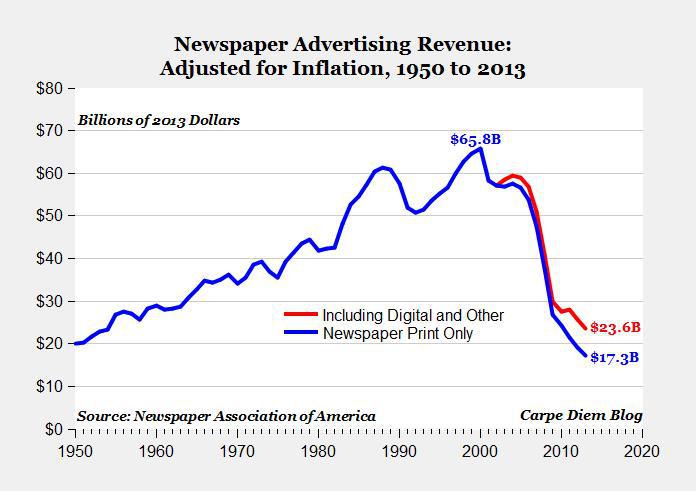 Slate chart of newspaper revenue