The post is a response to criticism of an earlier essay arguing that LLMs are eating away at software careers. The author doubles down that this is not just another tool cycle. They claim newer coding agents, better harnesses, and agent-oriented documentation have already made a big jump in real workplace usefulness, that Jevons-style demand expansion will not save software jobs forever, and that the same pattern will move into law, finance, design, and other knowledge work as model wrappers improve. The core claim is blunt: if code production becomes cheap enough, much of today's paid programming gets commoditized.
Most readers did not dismiss that as hype. The dominant view was that software is unusually vulnerable because it fits
LLM strengths so well. Code has rigid syntax, huge public training sets, and fast feedback through tests. That makes routine implementation and bug-fixing the first white-collar tasks likely to collapse toward oversight work. A lot of people also accepted the uglier economic point that markets often reward software that merely appears to work, at least long enough, so maintainability alone will not protect jobs in the short run.
Where the conversation landed was more practical than apocalyptic. Knowledge by itself was not seen as durable protection, but neither was raw code output. What still looks defensible is the ability to frame problems, make tradeoffs under uncertainty, understand messy domain constraints, and take responsibility when things break. Several comments sharpened this into a split between "ticket takers" and people who decide what should be built in the first place. Others argued that LLM fears get overstated when people assume current progress rates and capital spending continue indefinitely. Even those skeptics mostly conceded that software work is changing now, not someday. The useful takeaway was not "AI replaces all engineers" or "nothing changes." It was that standard coding work is being compressed first, team sizes may shrink around a smaller number of accountable humans, and careers built mainly on implementation speed look much less safe than careers built on judgment, trust, and ownership.
human-in-the-loop.bearblog.dev
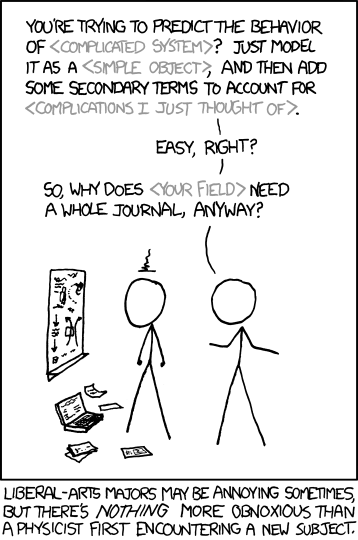 xkcd: Physicists